AI Orchestration is Strategic Discipline
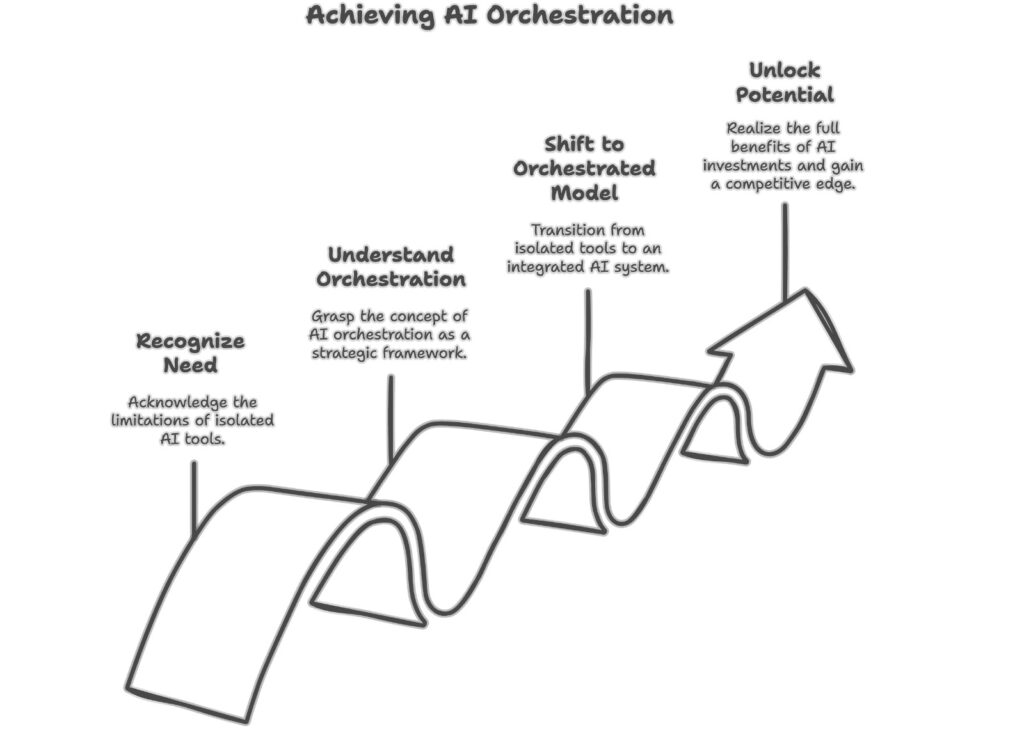
We are in an arms race for AI adoption. Businesses are acquiring sophisticated AI tools at a breakneck pace: a model for forecasting, an engine for personalization, a chatbot for service. Yet, for many, the promised revolution feels more like isolated pockets of innovation. The tools are powerful, but the results are disconnected. The ROI remains elusive. We have the components of intelligence, but no central nervous system to connect them, guide them, and make them work toward a unified business goal.
This is the critical, often-overlooked discipline of AI Orchestration. It’s not just another piece of technology; it’s the strategic framework for transforming a portfolio of disjointed AI assets into a single, cohesive intelligence engine.
From Fragmented Tools to a Cohesive Intelligence Core
Most organizations operate with a “hub-and-spoke” model for their AI. A marketing team uses its AI, a logistics team uses another, and a customer service team uses a third. Each works in its silo, optimizing a single function.
AI Orchestration flips this model on its head. It creates a dynamic, interconnected web where insights and actions flow freely between models and business units.
- Consider a retail scenario: A customer’s negative interaction with a support chatbot (an AI tool) doesn’t just end there. Orchestration triggers an immediate action. It can alert the personalization engine to pause aggressive marketing to that user, notify a human agent for follow-up, and feed the interaction data back into the chatbot’s learning model to prevent a repeat failure. The system learns and adapts as a whole, not in pieces.
- In manufacturing: A predictive maintenance AI on the factory floor detects a potential machine failure. Instead of just sending an alert, an orchestrated system automatically consults the production planning AI to reschedule workloads, checks inventory systems for spare parts, and updates the supply chain logistics AI to reflect potential delays. What was once a reactive crisis becomes a seamlessly managed operational adjustment.
This is the tangible difference between owning AI tools and deploying an AI strategy. Orchestration ensures that the whole is vastly greater than the sum of its parts.
The Strategic Imperative: Why Orchestration is Non-Negotiable
Adopting this approach moves AI from a tactical tool to a strategic asset. The benefits are not just operational; they are foundational to competitive advantage.
- Radical Efficiency: The primary value is the elimination of “process gaps” the manual, error-prone spaces between automated tasks. This is where immense operational drag and cost are hidden. Orchestration automates the entire value chain, not just steps within it.
- Compound Intelligence: When your AI models are orchestrated, they learn from each other. The insights from your sales forecast AI can automatically refine the parameters of your inventory management AI. This creates a powerful feedback loop, where your entire system gets smarter, faster.
- True Business Agility: In an orchestrated environment, adding a new AI capability is like adding a new instrument section to an orchestra, not building a new concert hall. You can plug new models into the existing framework, allowing you to adapt to market changes with speed that siloed competitors simply cannot match.
Moving to an Orchestrated Model: First Steps
Transitioning from isolated tools to a unified strategy requires a shift in mindset and architecture.
- Audit Your AI Portfolio: Don’t start by buying an “orchestration platform.” Start by mapping your existing AI tools and, more importantly, the business processes they serve. Identify the gaps between them. Where does a process stop and require manual intervention to begin the next? That’s your starting point.
- Prioritize a Single, High-Impact Value Chain: Don’t try to boil the ocean. Select one critical, cross-functional process (e.g., “order-to-delivery” or “lead-to-conversion”) and make it your pilot project for orchestration. Demonstrate definitive value here to build momentum.
- Think ‘API-First’: When acquiring any new AI tool, make its ability to integrate and communicate via APIs a primary purchasing criterion. A closed-off “black box” solution, no matter how powerful, will become a bottleneck in an orchestrated ecosystem.
The conversation around AI needs to mature. Simply acquiring more AI is a losing strategy. The real competitive advantage will be built by the organizations that master the discipline of making their AI work together. AI Orchestration is the blueprint for doing exactly that. It’s how you finally direct your collection of powerful tools to perform a single, masterful composition: your business strategy